 EN

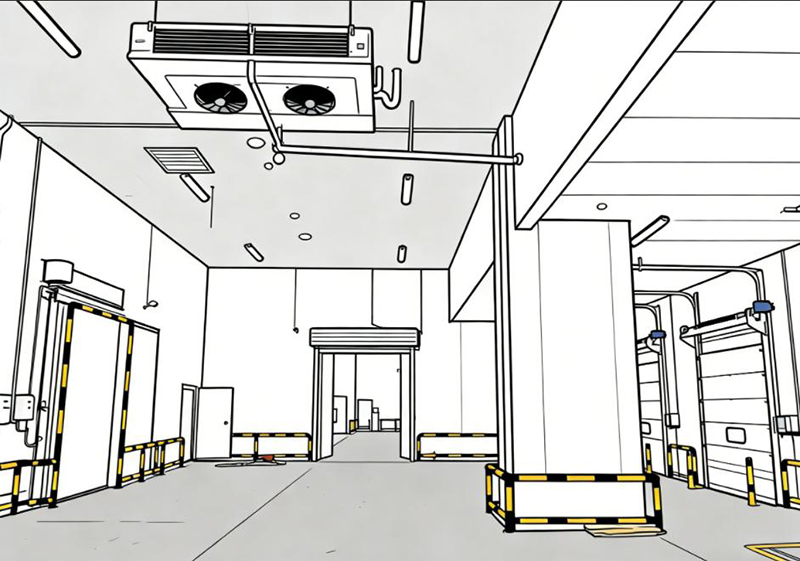
The World's Largest "Refrigerator" Can Hold the Entire City of Rome.
The global cold storage network is vast beyond imagination. For instance, the total storage capacity of one of North America's largest cold storage operators exceeds 400 million cubic feet (approx. 11.3 million cubic meters). To put it simply, this is enough space to contain the entire volume of all buildings in the ancient city of Rome. These are not just warehouses; they are hidden "frozen cities."
Cold Rooms are "Time Capsules," Preserving Humanity's Future.
Cold room doesn't just hold food; it safeguards human civilization and future. The most famous example is the Svalbard Global Seed Vault in the Norwegian permafrost, known as the "Doomsday Seed Vault." It stores over 1 million seed samples from around the world, acting as a "backup hard drive" for global agriculture in case of a worldwide catastrophe. Furthermore, there are cold stores holding precious DNA samples, historical documents (to prevent degradation), and even human remains, making them modern-day "time capsules."
Cold Rooms Can Suffer from "Altitude Sickness."
The efficiency of a cold room's refrigeration system is closely related to its altitude. At high altitudes, the thinner air reduces the heat dissipation efficiency of the condensers. Therefore, the same refrigeration unit will perform significantly worse in Lhasa (3,650 meters above sea level) than in Shanghai (4 meters above sea level). Engineers must recalculate and select unit specifications based on altitude, essentially giving the cold store a "specialized oxygen mask."
The "Silent" Cold Room: A Luxurious Space for Chocolate.
Premium chocolate is highly sensitive to odors and can easily absorb them. Therefore, cold rooms for chocolate have extremely strict requirements: materials that produce odors (like certain paints or insulation) cannot be used inside, and some even require independent refrigeration systems to prevent outside food odors from entering. These cold stores are like silent, odor-free five-star hotels built specifically for chocolate."
The Cold Room's "Weight Loss" Secret – Preventing "Freezer Burn."
Frozen meat can mysteriously "shrink" during storage, a phenomenon known as "freezer burn" or "shrinkage." This is caused by the sublimation of moisture from the product's surface due to the constant air circulation inside the cold store. A steak stored for a year could lose 2%-5% of its weight—all evaporated juice and profit! Modern advanced cold stores combat this by precisely controlling humidity, air velocity, and using controlled atmosphere technologies, essentially giving frozen products a "moisturizing SPA."
The "Frozen Fleet" of the Cold War.
During the Cold War, the United States had a top-secret project to mothball entire naval ships in massive cold storage facilities (actually dry desert storage, but the principle was to isolate them from the environment) in California, ready for rapid deployment in case of war. This "Ghost Fleet"was effectively put on pause, with rust and aging dramatically slowed by the low temperature and dry conditions. This is an extreme example of cold room technology applied to military logistics."
Cold Rooms Can Also "Generate Power" – Thermal Energy Recovery.
While refrigerating, cold rooms expel a large amount of waste heat. Modern green cold rooms can recover this "waste heat" to warm offices, pre-heat water, or even provide heating for nearby districts. This is like the cold room working a second job as a "heating supplier" while it cools, achieving energy recycling in a very eco-friendly way."
The World's Most "Expensive" Cold Air.
In scientific research, there are ultra-low temperature cold stores approaching absolute zero (-273.15 °C), used to store quantum computer chips, special superconducting materials, etc. The cost of maintaining such extreme temperatures is enormous. The value of the electricity consumed and the technological complexity make every breath of "cold air" in these facilities incredibly precious."
Some Cold Stores are Built for "Speed Dating," Not Long-Term Relationships.
This refers to the fundamental difference between a Blast Freezer (for rapid freezing) and a Storage Freezer (for long-term storage). Blast freezers are like a whirlwind romance, using extremely high-speed cold air to freeze products as fast as possible to lock in quality. Storage freezers, on the other hand, are like a stable marriage, providing a calm, steady environment for the long haul. Putting unfrozen products directly into a storage freezer is like expecting a comfortable marriage to provide the excitement of a first date—it won't work and will stress the system."
There's an Invisible Battle Against Ice "Bulldozers" Going on Inside.
Frost buildup on evaporator coils is a formidable enemy. If the defrost system fails, frost acts like a bulldozer, creating a thick, insulating "quilt" that blocks airflow and drastically reduces cooling efficiency. The cold store's control system is the commander in this battle, launching regular "thermal attacks" (defrost cycles) to melt the frost away. A failed defrost is like losing a key battle, causing temperatures to rise and energy consumption to soar."
FAQ
Q1: What are your main product lines?
A1: We offer three core product lines:
• Cold Storage Panels (Insulated Panels): For constructing various cold rooms and refrigerated spaces.
• Refrigeration Units: Including industrial freezers, screw chillers, air-source heat pumps, and more.
• Ice-Making Equipment: Industrial ice makers, blast freezers, and quick-freeze tunnels.
• We also provide integrated turnkey solutions ranging from -60°C ultra-low temperature cold rooms to large-scale logistics cold chain centers.
Q2: What temperature range can your cold rooms achieve?
A2: Our cold rooms cover a wide temperature spectrum, customizable to your needs:
• Chilling Rooms: 0°C to 10°C
• Freezing Rooms: -18°C to -25°C
• Ultra-Low Temperature Rooms: Down to -60°C
• Blast Freezers & Tunnels: For rapid freezing processes
Q3: Are your products energy-efficient and environmentally friendly?
A3: Yes. We are committed to green cold chain technology. Our products feature high-efficiency compressors, eco-friendly refrigerants, and intelligent control systems to optimize energy consumption, helping clients reduce operational costs while complying with international environmental standards.
Q4: Can you customize non-standard sizes or cold rooms with special functions?
A4: Absolutely. We specialize in custom solutions and can provide fully personalized design and manufacturing based on your site conditions, temperature requirements, stored materials, and other specific needs.
Q5: What services do you provide throughout the project cycle?
A5: Our standard service process includes six stages:
1) Requirement Listening – Understanding your temperature, dimensions, application, etc.
2) Technical Drawing & Design – Engineers provide layout and technical solutions.
3) Solution Proposal & Quotation – Detailed configuration list and pricing.
4) Shipping & Logistics – Professional packaging and global delivery.
5) Installation & Guidance – On-site installation by our engineers or comprehensive remote guidance.
6) After-Sales Support – One-year warranty + lifetime technical service.
Q6: Do you handle installation, or is it done by the client?
A6: We offer two options:
A: We Install – We dispatch engineers for on-site installation and commissioning.
B: Remote Guidance – We provide complete drawings, video tutorials, and technical support.
You can choose the method that best suits your project needs and budget.
Q7: What international trade terms do you support?
A7: We flexibly support various trade terms such as FOB, CIF, EXW, and others, negotiable based on your logistics arrangements.
Q8: What documents do you provide with shipments?
A8: Each shipment includes complete export documentation:
Commercial Invoice
Packing List
Certificate of Origin
Product Qualification Certificate and Operation Manual
Q9: Which countries have you exported to?
A9: Our products have been successfully exported to over 80 countries worldwide, including regions in Europe, North America, Southeast Asia, the Middle East, and Africa, with extensive international project experience.
Q10: What is the typical timeline from consultation to delivery?
A10: The timeline varies based on project complexity:
Standard Products: 15–30 days
Custom Projects: 30–60 days (including design, production, and shipping)
We coordinate production schedules according to your urgency to minimize lead times where possible.
Q11: How can I get a quotation or start cooperation?
A11: You can reach us through:
Sending your requirements to our company email.
Contacting us via the phone or form on the "Contact Us" page of our official website.
Speaking directly with our sales engineers for a free consultation and solution design.
Table of Contents
- The World's Largest "Refrigerator" Can Hold the Entire City of Rome.
- Cold Rooms are "Time Capsules," Preserving Humanity's Future.
- Cold Rooms Can Suffer from "Altitude Sickness."
- The "Silent" Cold Room: A Luxurious Space for Chocolate.
- The Cold Room's "Weight Loss" Secret – Preventing "Freezer Burn."
- The "Frozen Fleet" of the Cold War.
- Cold Rooms Can Also "Generate Power" – Thermal Energy Recovery.
- The World's Most "Expensive" Cold Air.
- Some Cold Stores are Built for "Speed Dating," Not Long-Term Relationships.
- There's an Invisible Battle Against Ice "Bulldozers" Going on Inside.
- FAQ